The End of Traditional VPNs: Why Modern Enterprises and Industrial Operations Must Transition to SSE/SASE (Zero Trust)
In an era where work has shifted to hybrid models and business data is increasingly driven by the cloud (Cloud-First), the traditional organizational “walls” or network perimeter have effectively disappeared. If your organization still relies on VPNs and legacy security architectures, you may be unknowingly leaving the door open to cyber threats.
This article takes executives and IT professionals deeper into why SSE (Security Service Edge) and SASE (Secure Access Service Edge), built on a Zero-Trust architecture, have become the new standard no organization can afford to ignore.
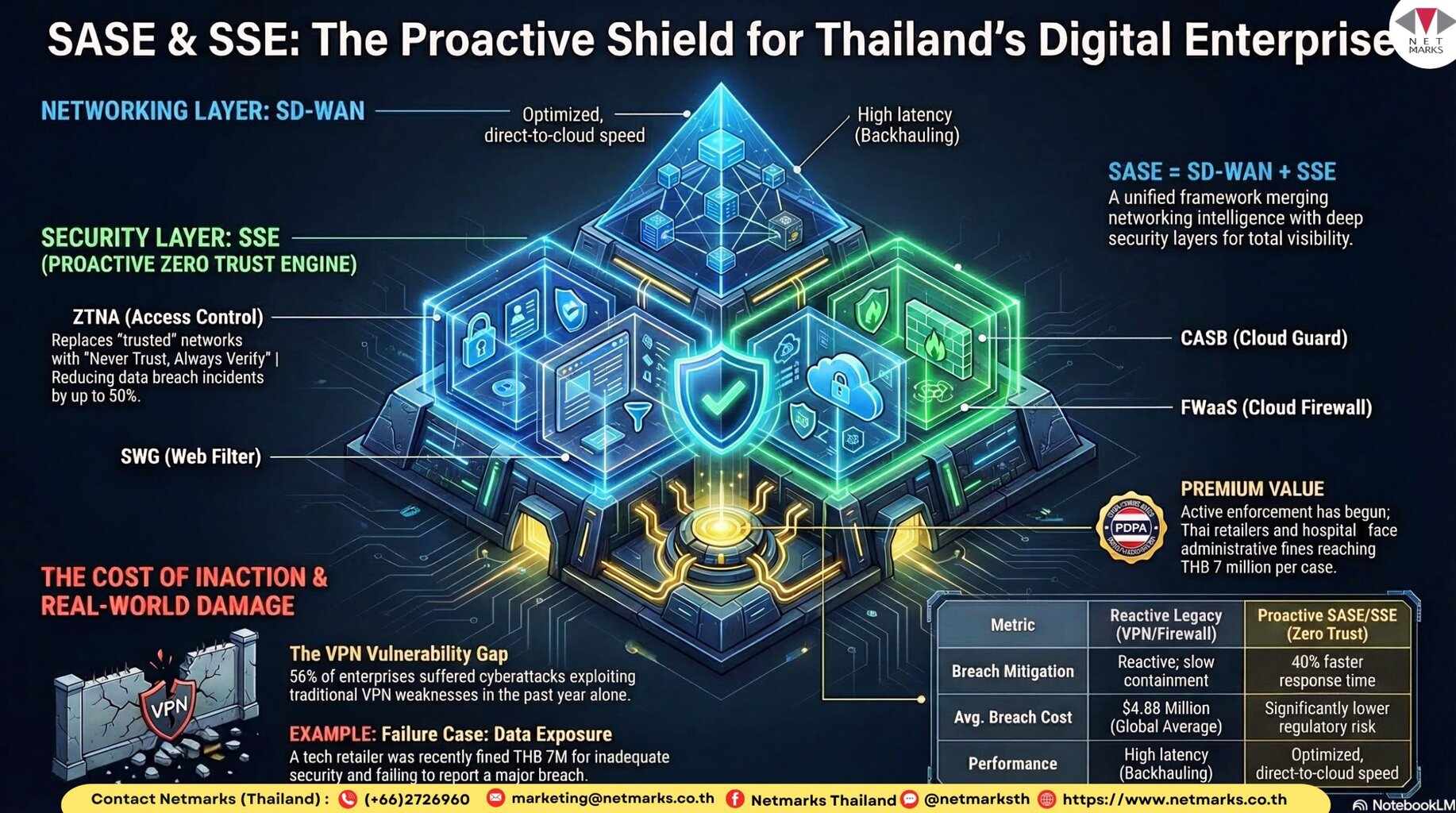
1. The Core of SSE/SASE: Driven by the Zero-Trust Philosophy
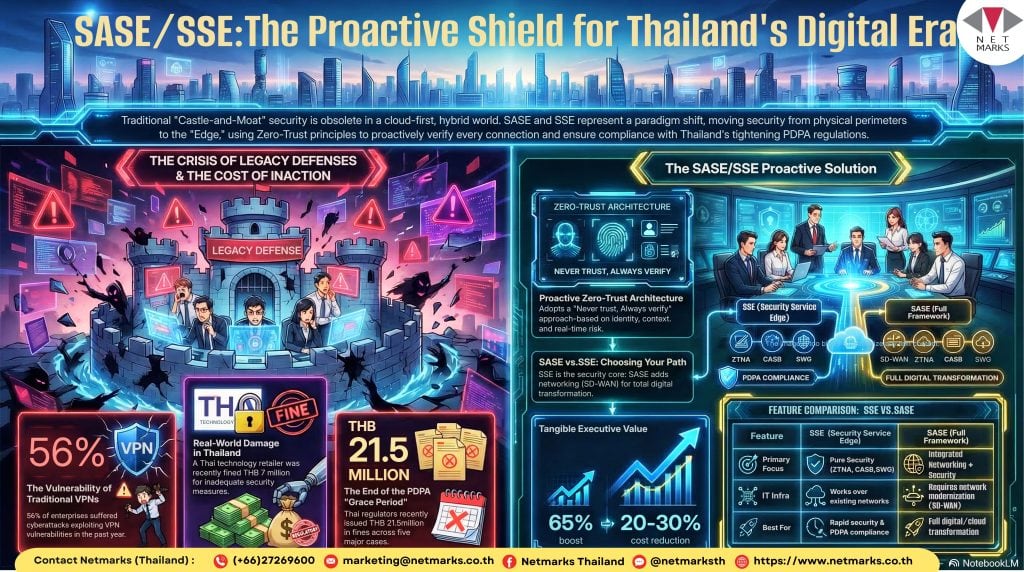
The old assumption of “trusting anyone who connects to the corporate network” is no longer valid. SSE/SASE shifts the paradigm to Zero Trust: “trust no one, not even those inside.” Every connection must be authenticated, its context verified, and access granted only to the specific data or resources required.
2. The Key Difference: SASE (Zero Trust) vs. Traditional VPN
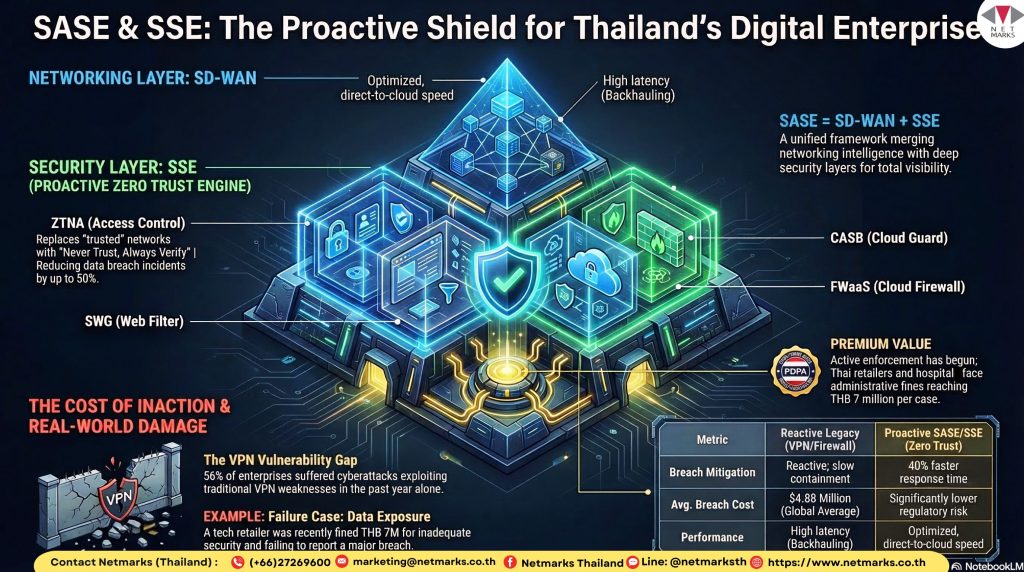
- VPN (Traditional): When employees work outside the office, their access to cloud resources is backhauled through a central data center first. This creates bottlenecks, slows performance, and—most dangerously—if hackers obtain VPN credentials, they may gain broad access across the network.
- SASE/SSE (Modern): Employees connect directly to the cloud (Direct-to-Cloud), reducing latency. And if a breach occurs, the damage is contained to a limited area through micro-segmentation, preventing it from spreading across other systems.
3. Eliminating Pain Points for Both IT Teams and End Users
- No more sluggish connections: Work becomes smoother because users no longer have to pass through narrow VPN bottlenecks.
- Remove blind spots: Gain full visibility and control over application and data usage, including Shadow IT, even when employees use personal devices (BYOD).
- End tool sprawl: No need to manage multiple security solutions from different vendors. SASE consolidates Firewall, SWG, CASB, and ZTNA into a single cloud-based platform.
4. Return on Investment (ROI) and Staying Ahead of PDPA Compliance Risks
Statistics indicate that more than 56% of organizations have experienced attacks through VPN vulnerabilities. Beyond that, Thailand is now enforcing the PDPA more seriously, with cases such as an IT retail business being fined as much as 7 million baht following a data breach.
Investing in SASE is therefore not merely an expense—it is a safeguard for both your budget and your organization’s reputation. It can also reduce long-term IT TCO (Total Cost of Ownership) by as much as 20–30%.
5. Key Benefits That Create a Business Advantage
Organizations gain a new level of agility. Employees can work securely from anywhere in the world. Opening a new branch office or factory can be done immediately without investing in expensive on-site security hardware for every location.
6. The Price You Pay by Choosing to “Save Money” with Legacy Approaches
Choosing not to invest in SASE today means accumulating technical debt. Your organization may face significant losses from ransomware, employee frustration caused by slow systems, and reputational damage if customer data is exposed.
Conclusion
“Don’t wait for a PDPA fine or a ransomware payment to force change. Protecting your organization today is no longer about ‘location’—it is about ‘identity.’ Leave behind crumbling perimeter defenses and empower your business with Zero Trust, because the best security is security that follows your workforce everywhere, seamlessly.”
📥 Download the full Infographic and Executive Slide Deck — FREE
Simply add Netmarks Line OA Type 👉 “SASE” to download the file.
If your organization is ready to move toward a future-ready architecture, the team at Netmarks (Thailand) is pleased to offer consultation and a free initial system assessment.
You can contact us at:
 Website: https://www.netmarks.co.th
 Line OA: @netmarksth
 Contact Us: https://www.netmarks.co.th/contact-us
 E-mail: marketing@netmarks.co.th
 Tel: 0-2726-9600